
Ocular herpes is a fairly common condition that can be very serious. Without appropriate treatment, the eye may be lost. Current medications enable good healing and fairly rapid scarring, but they do not prevent possible recurrences.
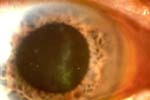

Any painful eye must be examined by an ophthalmologist, who will be able to diagnose the lesions and prescribe appropriate treatment. Certain drugs (corticosteroids) are strictly contraindicated and lead to the loss of the eye. Ocular herpes is not very contagious and it is rare for ocular herpes to be bilateral. The most frequent ocular herpes is caused by herpes simplex, virus type 1 (HSV 1). This is a germ very widespread in the population but fortunately, few people develop ocular herpes. After infecting the host for the first time (primary infection), the virus will settle in the ganglia corresponding to the ocular area and can reappear later. It is then, on these reactivations, that the symptoms of recurrent ocular herpes appear.
The herpes simplex virus
There is a herpes simplex virus type 2 (HSV 2) that seems rather localized in the regions of the body situated below the belt (genital herpes…) and it is much less frequent than type 1 at the eye level. This virus has a double-stranded DNA surrounded by an icosahedral capsid composed of 162 capsomeres. With a diameter of 100 nm, the virus contains specific proteins at the level of the envelope and in particular gC glycoproteins which characterize type 1 or type 2.