
It is characterized by aclouding of the lensleading to impaired vision. Usually slowly progressive, it causes increasingly troublesome vision loss.
At first, the patient is troubled by abnormal sensitivity to light (photophobia), especially pronounced under strong light (glare in sunlight or when driving at night) which may be accompanied by reflex tearing. Gradually, the vision loss becomes more and more challenging and hinders the most common daily activities, leading to the indication for surgical intervention.
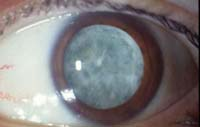
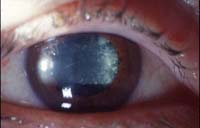
There are several types of cataracts:
- cataract in the elderly, the most common, due to theaging of the lens.
-congenital cataract, a familial condition, whose early detection in very young children may indicate a more or less rapid surgical intervention depending on the severity of the lens opacity.
-traumatic cataract, which usually evolves rapidly.
- cataract secondary toserious eye conditions(chronic uveitis, previous retinal detachment, neglected diabetes). Surgery is the only possible treatment.
The procedure consists of removing the nucleus of the clouded lens either by simple extraction (without fragmentation of the nucleus), or by phacoemulsification (the nucleus is fragmented by a vibrating suction probe at ultrasonic frequency introduced into the eye). The advantage of the latter technique is that it involves only a very limited opening of the eyeball and allows for faster visual recovery.