Fondation Bouamatou
Glaucoma
The term glaucoma refers to an increase in intraocular pressure causing damage to the optic nerve.
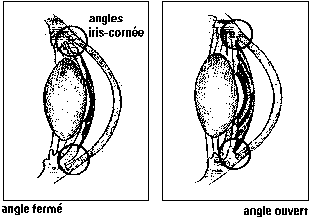
This is a serious eye disease almost invariably manifested by an increase in intraocular pressure which can take two main forms:
- angle-closure glaucoma (A.C.G.), which develops acutely;
- open-angle glaucoma (O.A.G.), which evolves slowly and is accompanied by very few functional symptoms.
Angle-closure glaucoma (A.C.G.)
Formerly called Acute Glaucoma, it is a sudden complication of a pre-existing anatomical abnormality that was previously silent. An angle-closure glaucoma attack can only occur in an individual with an abnormality at the iridocorneal angle. This angle is congenitally narrow. Under the influence of various factors, this narrow iridocorneal angle closes, thus preventing the drainage of the Aqueous Humor towards the extraocular spaces. Since the secretion of aqueous humor is constant, this leads to a rapid and irreducible increase in intraocular pressure. Within a few hours, the pain becomes unbearable, and vision collapses.
Treatment of an A.C.G. attack is a medical emergency:
- medical, to lower the intraocular pressure as quickly as possible;
- then surgical. Peripheral iridectomy by laser or surgical method. This procedure permanently protects the patient from a recurrence. As the iridocorneal angle abnormality is most often bilateral, surgical treatment will be applied to the other eye as a preventive measure.
Open-angle glaucoma (O.A.G.)
Formerly called Chronic Glaucoma, this is an eye condition that is all the more serious because it evolves slowly and practically without warning signs. Open-angle glaucoma is the most frequent cause of blindness in developed countries after diabetes.
The disease is caused by an impediment to the drainage of the Aqueous Humor towards the extraocular spaces. In this case, the iridocorneal angle is of normal width, but the "filter" through which the aqueous humor must pass to exit the eye is of poor quality.
As a result, intraocular pressure tends to rise to overcome this "barrier," causing irreversible damage to the optic nerve. This is damaged at its origin, the optic disc, resulting in alterations of the visual field and progressive vision loss.
Screening for the disease by systematically measuring intraocular pressure during ophthalmologist consultations allows for early diagnosis and prompt initiation of treatment.
Treatment of wide-angle glaucoma is either medical (eye drops) or surgical, depending on the severity of the condition and its rate of progression.